Read below for an excerpt from Officer Jablonski - coming soon!
Prologue—June 27, 1929:
Tonight Danny Keegan was going to ask Noreen for her hand in marriage. It was about time. Their courtship had been long, stretched out by the “white plague” and Noreen’s fourteen-month stay at the Maybury Sanatorium out in Northville.
Last fall, unable to isolate safely at home, Noreen surrendered her privacy to the red brick walls of the sprawling 300-acre campus. A long, sterile corridor lined with narrow beds positioned across from large south-facing windows became both her salvation and her prison. The windows, always open even in the bitter cold of winter, provided her with the only treatment other than strict bed rest: sunshine and fresh air. She had once been told the panes were repurposed X-ray plates from Herman Kiefer Hospital in the city, another reminder that she was kept under constant examination.
Now that Noreen was home, Danny was eager to settle down and begin their life together. It was 1929, and the American economy was booming. Times were good and he wanted some of that good for himself and Noreen.
He purchased the ring, a white gold filigree hexagonal bezel setting with a single small diamond, from Simmons & Clark Jewelers downtown on Broadway. With one dollar down and one dollar a week, he made his final payment just last week.
But before tonight, he had to get through today and finish this drop off. Danny worked as a driver for the Ford Motor Company. Danny’s father was a police officer, and Todd had once hoped to follow in his footsteps, but his 5’2” frame had kept him from ever making the department’s height requirements. He had inherited his father’s quick wit and strength, but his mother’s stature as well. Still, his father had pulled a few strings and secured him the opportunity at Ford. So far, Danny was doing well, better than expected, and there was talk of a promotion. Things, at last, were looking up for him.
For the most part, it was a low-stress job. Danny drove important executives to meetings and errands around the self-contained industrial city south and west of downtown, the River Rouge Complex. Thursdays however, were different. Those were his biggest, most important days.
On Thursdays, he drove a Ford Model A sedan from the First National Bank of Detroit to the payroll office to supply cash for the payroll. Two coworkers, Mike Johnson and Will Stevens, also trusted Ford employees, rode in the back, armed with revolvers, guarding the locked cash boxes as they made their way through the city.
No Thursday was the same. They took different routes and left at different times, all to prevent predictable patterns and deter would-be thieves. They never learned their drive route until arriving at the bank on Thursday mornings. They never knew who established the route; it was treated as a tightly held secret and never explained.
Sometimes they would do two runs, sometimes one. Two runs spread out the potential loss but one run was more efficient. There was talk of getting a specialized armored car but nothing had happened quite yet. Although timing varied, everything had to be in place by 12 noon on Thursdays. Over 50,000 people worked at the complex and it took time to organize, count, and distribute the payroll.
The payroll itself was carried in small denominations—mostly fives, tens, and twenties. The average wage was roughly six dollars a day, and with a six-day workweek, most men earned about thirty-six dollars weekly. Once delivered to the central payroll office, the money entered a system as precise and segmented as the assembly lines outside. Clerks worked in sequence, channeling wages to departments across the steel mills, foundries, assembly lines, and power plants.
Within each department, wages were sorted by hand into day, night, and rotating shifts, then further divided among skilled workers, laborers, and supervisors. Each week, the cash was counted and sealed into individual envelopes, ready for distribution by foremen or designated pay clerks. At the end of the week, workers lined up to receive their pay one by one, the week’s labor reduced to a single envelope.
Detroit in 1929 was a city steeped in danger. Gangs operated openly, and Prohibition was in full swing. Just the month before, a family of six had been brutally murdered and decapitated with an ax in their own home, with police still no closer to identifying a suspect.
What would be her reaction he thought to himself as he pulled on to Eagle St. off of Dix.
Ahead of him at the first intersection with Amazon St. he could see an accident, an all too common sight on the streets these days. Two cars, a model T and what looked to be some sort of Packard had collided. Steam was emanating from beneath the hood of the Model T and both drivers were furiously gesturing and yelling at one another. A Detroit Police officer, dressed in formal blues, waved them over to the oncoming lane, his white gloves pointing the way. As they threaded carefully around the obstacle and accelerated, Danny felt a heart wrenching jolt and was momentarily stunned as he was knocked forward into the windshield, In the back, both Mike Johnson and Will Stevens were similarly knocked off balance and left in a state of confusion.
As he came to, Danny was on the ground and his hands and feet were tied with ropes. Both Mike and Will were beside him, incapacitated in the same way. What had just happened? The model A lay mangled in front of him and he saw a chain attached to the rear cross member. The back door lay open and the lockboxes and all of the payroll were gone.
***
Glancing out her driver’s side window, Frankie Jablonski gasped in surprise. The familiar figure motioning for her to pull over was someone she hadn’t seen in several months and someone she most definitely was not prepared to see today.
Pulling the steering tiller toward her, she guided her dark blue Detroit Electric Model 90 coupe to the right side of Jefferson Avenue, then pressed firmly on the large brake pedal with her left foot, bringing the car to a stop.
A tall man stepped out of the black Model A police cruiser, his green eyes lively beneath a mane of glossy black hair, neatly combed back from his face. As always, he was impeccably dressed. He wore a light brown linen suit, single-breasted with notched lapels and three buttons, perfectly tailored to his frame. His high-waisted trousers were held up by chestnut brown striped suspenders that crossed over a crisp white-and-green striped shirt with semi-spread collar. A broad dark brown tie was tucked neatly into his waistband. And, just as she remembered from their past encounters, every piece of clothing was sharply pressed, not a wrinkle in sight—even in the sticky warmth of a Detroit summer afternoon.
As he approached her car, what always happened when Detective Fleming was near started to happen. Her cheeks felt warm and patches of red started appearing on her face and neck, turning a deeper and deeper shade of red. When she reached for her door handle to get out to greet him, he enthusiastically said, “Don’t bother. I’d like to hop in on the other side if you don’t mind. I’ve seen these around for several years and I’ve never got to be in one.”
Putting her right hand over her left to hide the subtle nervous tremor that was starting, she said in the flirtatious manner that always came out of nowhere whenever Fleming was around, “Do I have any choice?”
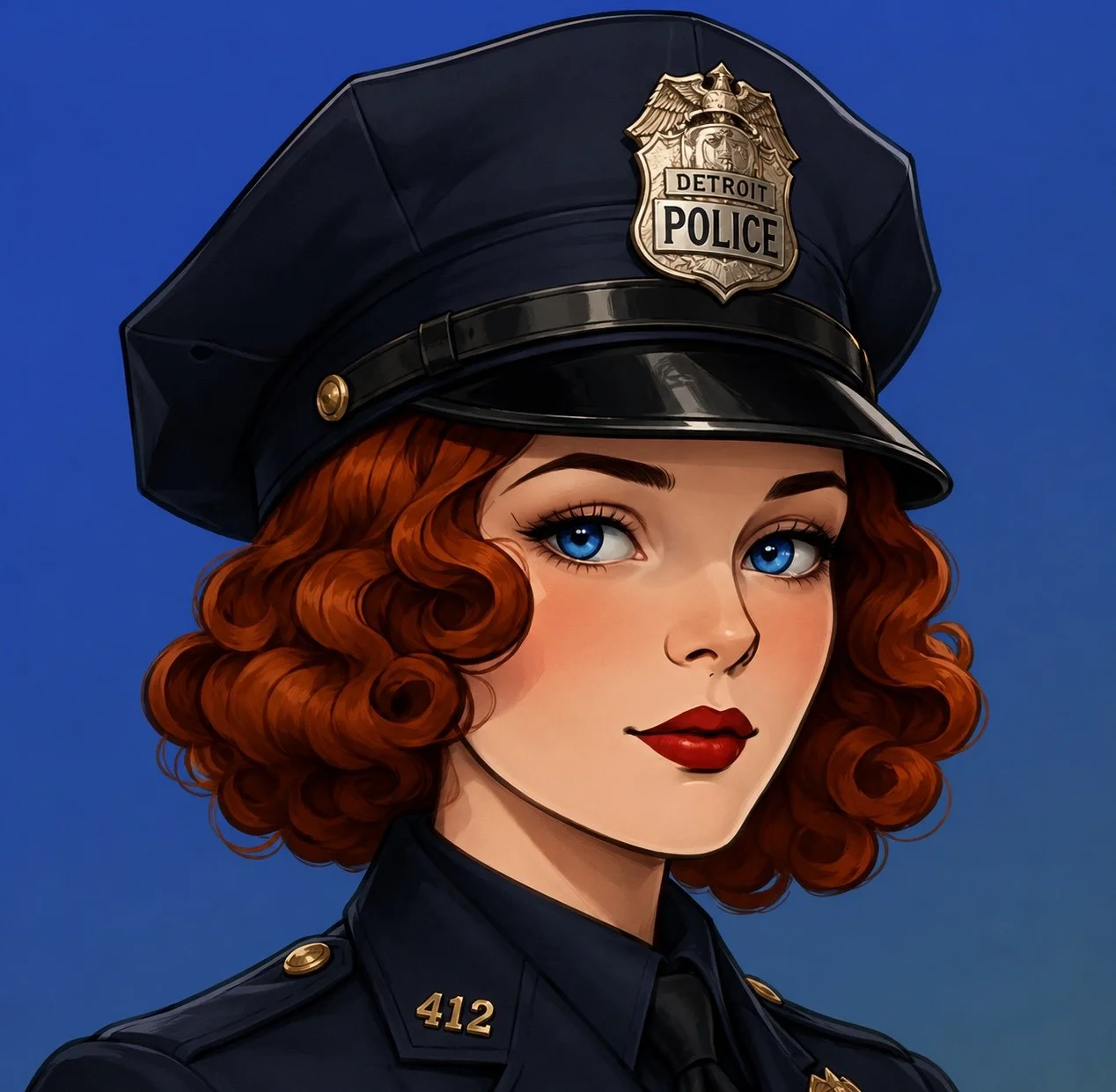
At this point the burgundy nature of her blushing skin matched the appearance of her hallmark feature, her full head of bouncy, thick, lustrous auburn curls. Today, they were styled in her favored Gibson tuck with a few small loose ringlets framing her face. She was dressed in a simple, light-blue cotton, drop-waist dress with a subtle V-neckline that complemented her cornflower blue eyes perfectly. She’d dressed for the sweltering summer sun, never expecting the added heat that would come from the attention of a certain charming police detective.
To one side of Frankie, the city of Detroit rose proudly, its skyline transformed by the roaring success of the automobile industry. Towering office buildings, luxurious theaters, and grand hotels stretched skyward, symbols of a city on the rise. Directly in her line of sight, the Guardian Building was taking shape—its bold Art Deco lines beginning to emerge—while just beyond it, the newly completed Penobscot Building stood as a finished testament to the same architectural style. On her other side flowed the Detroit River, and beyond it, the not-too-distant shore of Canada came into view.
It was 1929, and Prohibition still gripped the United States, making the sale and distribution of alcohol illegal. Just across the water sat Windsor, Ontario—home to Canadian Club whiskey and a crucial player in the thriving, illicit rum-running trade that fueled Detroit’s underground economy and after-hours excitement.
It had been just over six months since she’d last seen Fleming. The feelings he stirred in her had been too much to deal with at the time and so she had ignored his notes and invitations. What if he knew what you were really like? she wondered, the thought creeping in like a shadow she couldn’t quite shake.
Almost one year ago, Detective Fleming had led the investigation into the murder of Father Pzechowski, Frankie’s close friend and trusted priest. Drawn into the case herself, Frankie played a key role in uncovering the killer’s identity. Along the way, she crossed paths with the infamous Purple Gang—Detroit’s most feared crime syndicate—and quickly gained a reputation as an in-demand bootlegger, thanks to the rye whiskey she crafted in her basement.
Now that the case was behind her, Frankie was determined to turn over a new leaf. A widow for nearly two years, she had two young boys, Johnny and Eddie, to care for and a thriving seamstress business to run. She’d even started sharing her home and expenses with a childhood friend, bringing some long-needed stability to her finances.
And yet, she was restless.
Maybe that’s what led her to reach out to Vic Barbier, a former business associate of her old bootlegging partner. Maybe that’s how she ended up on the side of Jefferson Avenue, pulled over by a police detective—with thirty-two bottles of whiskey packed securely next to the batteries underneath the hood and in the trunk of her car.
“What a surprise to see you,” called out Fleming as he approached. “It’s been over six months. I’ve tried reaching out a few times. Can I ask—did I do something to offend you?”
Frankie, caught off guard by the kindness in his voice—and momentarily lost in those emerald eyes—shook her head. “No, not at all. It’s just... just...” she trailed off, glancing down to see her hands trembling ever so slightly.
“Hey,” he said gently, “just so you know—you haven’t done anything wrong. I spotted that red hair of yours from the other side of Jefferson. I was heading the opposite way but turned around just to say hello.”
Little does he know, Frankie thought, heart thudding.
Fleming glanced at her car. “I didn’t know you had a Detroit Electric. I thought your husband worked for Ford before he passed. I guess I expected you to be in a Model A or something.”
“This car was my husband Frank’s favorite. He had a thing for electric cars—swore they were the future. I just can’t bring myself to let it go.”
“If the future means going no faster than thirty miles per hour, no farther than fifty miles or so, and definitely not in the winter... then yeah, I’d say he was onto something,” he replied, grinning.
Oh my goodness, she thought. How do I end this? But at the same time, she didn’t want it to end. Not yet.
“I have to admit though, these are pretty nifty,” he said, running a hand along the door frame. “Quiet. Clean. Mind showing me around a bit?”
Was this actually happening? Frankie could hardly believe it. Here she was—trunk full of illegal whiskey packed safely next to the car batteries—possibly about to get caught... and all she could think about were those green eyes.
“How about we pull into that lot up ahead by the river?” Fleming asked with a grin. “I’ll leave my car there, and you can take me for a spin.”
And maybe I could offer you a shot of whiskey from the trunk, Frankie thought, half amused, half terrified.
Flabbergasted, she nodded and eased the car into the lot. Before she quite realized what was happening, she, Detective Elliot Fleming, and thirty-two bottles of the finest rye whiskey in Detroit were seated side by side, cruising down Jefferson Avenue.
She showed off the car with nervous pride—demonstrating the unique shifting bar,simple lever for speed control, the steering tiller, the curtains she customized for the windows and the tall curved vertical side windows that offered an unobstructed view of the world outside.She showed off the car with nervous pride—demonstrating the simple lever that controlled its speed, the steering tiller, the window curtains she had sewn herself, and the tall, curved side windows that offered an unobstructed view of the world outside.
Sitting next to Fleming, Frankie felt something stir. She felt alive again, the way she had back when she was chasing leads last fall, uncovering clues and brushing with the world outside of her small Polish immigrant community of Delray in Southwest Detroit.
Eventually, she drove him back to his car.
“Just one more thing,” he said, lingering by the passenger door. “Mind if I see the engine? These things fascinate me.”
At that, Frankie’s stomach dropped and the look on her face told Fleming something was amiss. Fleming’s tone shifted ever so slightly. Calm, but steady. “Frankie... I think you need to let me see under the hood. And the trunk, too.”
Fleming’s eyes widened. He slammed the trunk shut.
“What are you doing?” he demanded.
“Trying to turn over a new leaf?” she answered with hesitation.
“By distributing and transporting... Ryetousness? The storied rye whiskey that had the city drooling last year?” His voice was sharp with disbelief.
“How do you even know about Ryetousness? And for the record, I’m not distributing it. I made it,” she replied coolly.
Fleming blinked. For a man who’d always thought this woman couldn’t surprise him any further, he was proven wrong yet again.
“You what?” he asked, stunned.
“I made it a long time ago—back when Frank was still alive,” she said. “I made it and hid it in the basement. It turned out really well and actually helped me free Isaac,” referring to Isaac Samuelson, whom she helped clear when he was falsely accused of murdering Father Pzechowski.
Fleming ran a hand through his hair, exasperated. “I need the truth. All of it. No more half stories. There’s no point in hiding anything anymore.”
Frankie, who had already confessed her sins to her pastor Father Walczak, was growing more adept at untangling the web of lies she’d spun last fall. She took a breath and began—detailing, step by step, how, with the help of some unnamed friends, she’d gone from a widowed mother of two young boys and a quiet seamstress to a bootlegging, undercover “girlfriend” of a gang member, with an unexpected talent for uncovering secrets and solving crimes.
When she finished, she stood in silence, waiting for whatever punishment might come. She braced herself.
Fleming finally spoke, “There’s not much I can say about how reckless all of that was, or how dangerous. But I get it now. You’re going to do what you think is right, no matter what.”
He paused, his voice softer. “And against my better judgment... I care what happens to you.”
Frankie clasped her hands, uncertain, a flicker of fear in her eyes.
“I don’t have many options,” Fleming said. “You need to be somewhere I can keep an eye on you.”
Her thoughts spun wildly. Oh my God... how many years will she get for this? How old will Eddie be when she gets out?
“I’m giving you a choice,” he said. “I can bring you in, and you can face the consequences. Or... you can join us. Become an officer in the women’s division of the department.”
He paused, letting it sink in.
“A firm requirement is a college degree for women in the division—but with everything you did with the murder case last fall, I’m pretty confident I can pull a few strings and get that waivedwork something out.”
Frankie, seeing no real alternative—and, if she was honest, feeling a thrill at the idea—nodded.
“Be at the station Monday. Eight a.m. sharp,” he said with a faint smile. “Welcome to your new job, Officer Jablonski.”