The Detroit Electric
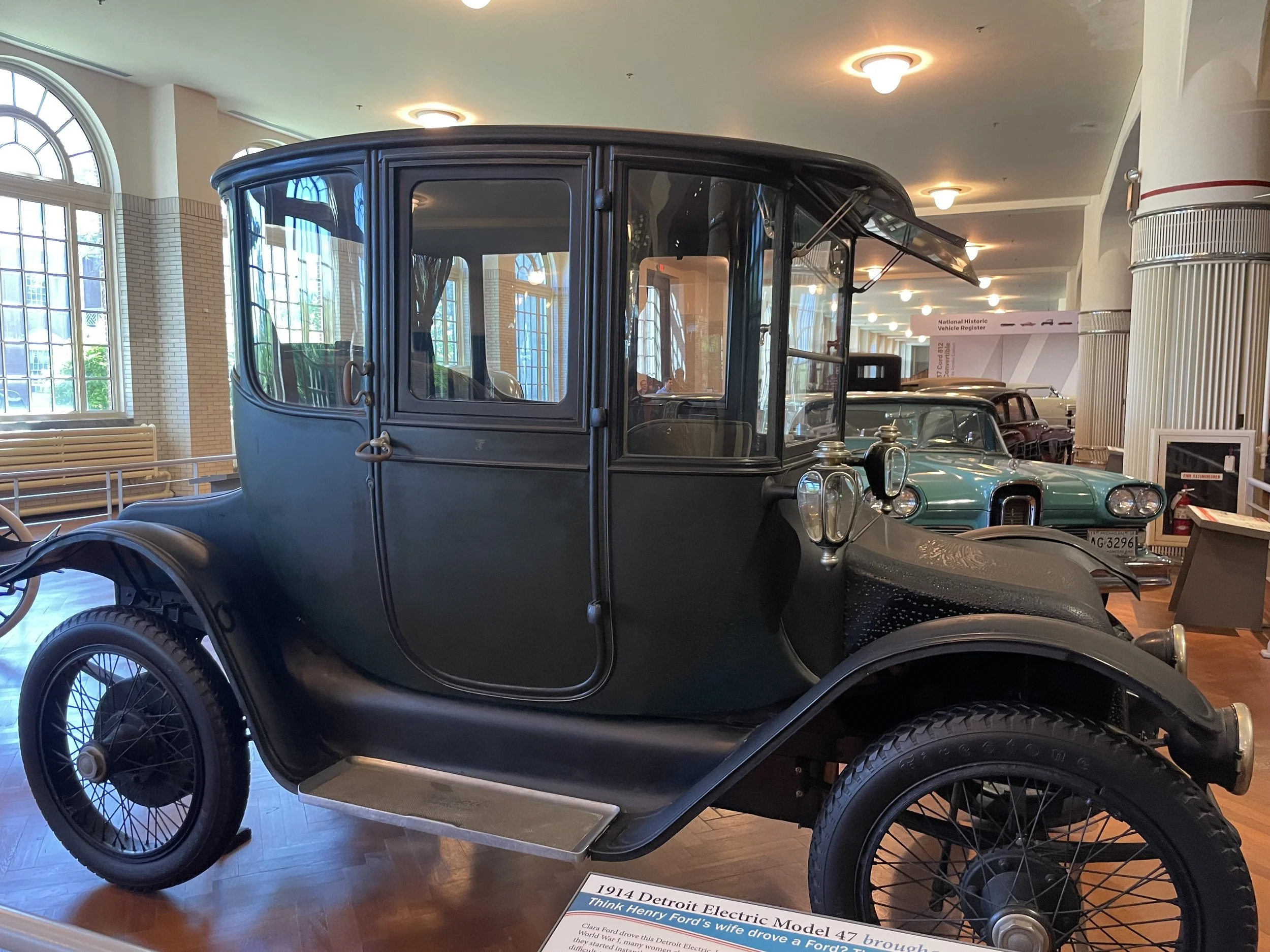
Detroit Electric coupe - Henry Ford Museum - Detroit, MI
Several years ago, I visited the National Car Museum in Reno, NV, and was surprised to see not just old cars, but several early electric cars—vehicles that looked like Model Ts but ran on batteries. That’s when I learned that electric cars were far from a modern invention.
A few years later, I toured the Henry Ford Museum of American Innovation in Dearborn, MI and encountered a gorgeous early electric vehicle: a Detroit Electric. This particular car once belonged to Clara Ford, Henry Ford’s wife. Clara, like other women the 1920s, preferred electric cars because they were clean, quiet, and—most importantly—easy to start. No hand-cranking required. I couldn’t believe it, Clara Ford didn’t drive a Ford at all; she preferred her Detroit Electric and its leather-covered hood, trunk and fenders.
I remembered this when I started thinking about Frankie and how she might navigate Detroit. A Detroit Electric felt like a perfect fit.
A quick YouTube search led me to an episode from Mike the Car Geek about Detroit Electrics, and I was completely enthralled. The elegant car, with batteries housed in both the front and rear, needed no radiator grille, giving it a clean, streamlined appearance. Tall, curved side windows offered wide, unobstructed views, while the plush interior—complete with a small bud vase—added a refined touch. The driver sat in the rear, steering with a tiller bar, and the front passenger sat in a seat facing backward. I didn’t want a Tesla, I wanted a Detroit Electric!
https://www.youtube.com/watch?v=kBZOYxFhjtw
Of course, even if Frankie and her husband saved diligently, owning a Detroit Electric would have stretched their finances. I needed a believable way for them to come into some money. That’s when I listened to an episode of one of my favorite podcasts, Criminal with Phoebe Judge and found out about the Numbers.
https://thisiscriminal.com/episode-108-the-numbers-2-15-2019/
Although that episode focused on the Numbers game in African American communities in Detroit, I found that Numbers betting was widespread among many immigrant neighborhoods across the city.
Electric vehicles themselves have a much longer history than most people realize. The concept dates back to 1837, when Robert Davidson of Aberdeen, Scotland, built an early electric locomotive prototype. Once rechargeable batteries were developed, electric vehicles became more practical. One of the first notable American electric cars was created by William Morrison, a Scottish immigrant living in Iowa. When his electric carriage debuted at the 1893 World’s Columbian Exposition, it drew enormous attention. It had a 4-horsepower motor, could reach speeds of about 20 mph, and had an impressive 50-mile range.
In the following decades, inventors experimented with steam, electric, and gasoline-powered cars, with no clear winner. Companies like Oldsmobile, Studebaker, and even Porsche built early electric models. In 1901, President William McKinley was transported in an electric-powered ambulance after he was shot in Buffalo, New York—a testament to how advanced these vehicles already were.
Founded in 1907, the Detroit Electric Company became one of the best-known electric car manufacturers of the era. Their vehicles could travel up to 80 miles on a single charge and reach speeds between 25 and 30 mph. Clean, quiet, and simple to operate, they were especially popular among physicians and affluent women.
Electric cars eventually fell out of favor after the invention of the electric starter, which eliminated the difficult hand-cranking required for gasoline engines. Combined with longer driving ranges and lower costs, gasoline-powered cars soon dominated the market. Now with improved battery technology, electric cars are making a reappearance once again.
”1922 Detroit Electric Coupe.” The Henry Ford, https://www.thehenryford.org/collections-and-research/digital-collections/artifact/237667/. Accessed 19 Apr. 2025.
Sadler, Bob. “The Detroit Electric and Its Place in Automotive History.” MotorCities National Heritage Area, 26 Jan. 2022, https://www.motorcities.org/story-of-the-week/2022/the-detroit-electric-and-its-place-in-automotive-history.
Wilson, Kevin A. “Worth the Watt: A Brief History of the Electric Car, 1830 to Present.” Car and Driver, 31 Mar. 2023,https://www.caranddriver.com/features/g43480930/history-of-electric-cars/.
